Question Tags
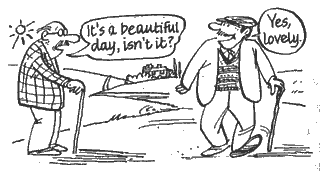
In English it is common to end the sentences with another short phrase, of the opposite sign, which has the intention of asking for the opinion or seeking approval from the interlocutor: these are called question tags. These phrases are equivalent to: right ?, Is not that right ?, right ?, Is not it? really?

Examples:
| You eat meat, don’t you?(Comes carne, ¿verdad?) |
http://www.langust.ru/unit_el/unit038b.gif
Grammatical Rules
To form question tags, we use the auxiliary verb from the main phrase in the opposite form plus the subject. If there is no auxiliary in the main phrase, we use “to do”.
If the sentence is affirmative, the question tag is therefore in the negative and vice versa.
Examples:
Affirmative sentences:
| Your brother is older than you, isn’t he? |
| You can help me, can’t you? |
| John is getting married, isn’t he? |
| You worked yesterday, didn’t you? |
| Sarah likes ice cream, doesn’t she? |
Negative sentences:
| You’re not from here, are you? |
| Kate’s not American, is she? |
| Peter never liked Susan, did he? |
| They didn’t go to class yesterday, did they? |
| You can’t dance, can you? |
Note: Be careful with the verbs “to have” and “have got”.
Examples:
To have got:
| They’ve got a dog, haven’t they? |
To have:
| They have a dog, don’t they? |
Exception: With the verb “to be” in the first person in affirmative sentences, we use the third person in the question tag (“aren’t”).
Examples:
|
https://www.curso-ingles.com/aprender/cursos/nivel-intermedio/questions/question-tags
Exercises: Question Tags
|